23 September 2026
Buy Wine Shipping Boxes: What to Specify Before Ordering
To buy wine shipping boxes, you first need a specification sheet that covers bottle count and dimensions, corrugated versus rigid construction, insert type, print and finish, and packing method. Get that sheet right and the rest of the order is execution. Skip it and you are guessing at fit, and fit is what breaks bottles.
Start with bottle count and dimensions
Bottle count sets the format: single, two, three, or multi bottle. But the number on the label is not the number that matters. Your bottle diameter and height drive the insert cavity and the outer box size. A 750 ml Burgundy bottle and a 750 ml Bordeaux bottle are not the same shape, and a shipper built for one will not hold the other. Measure the bottle you actually ship, not a catalogue spec.
Diameter decides how wide the cavity runs. Height decides how deep the box goes and whether the neck sits above the shoulder line. If you are shipping more than one bottle, the spacing between cavities matters as much as the cavities themselves. Too tight and the bottles rub. Too loose and they move. That is where transit damage starts.
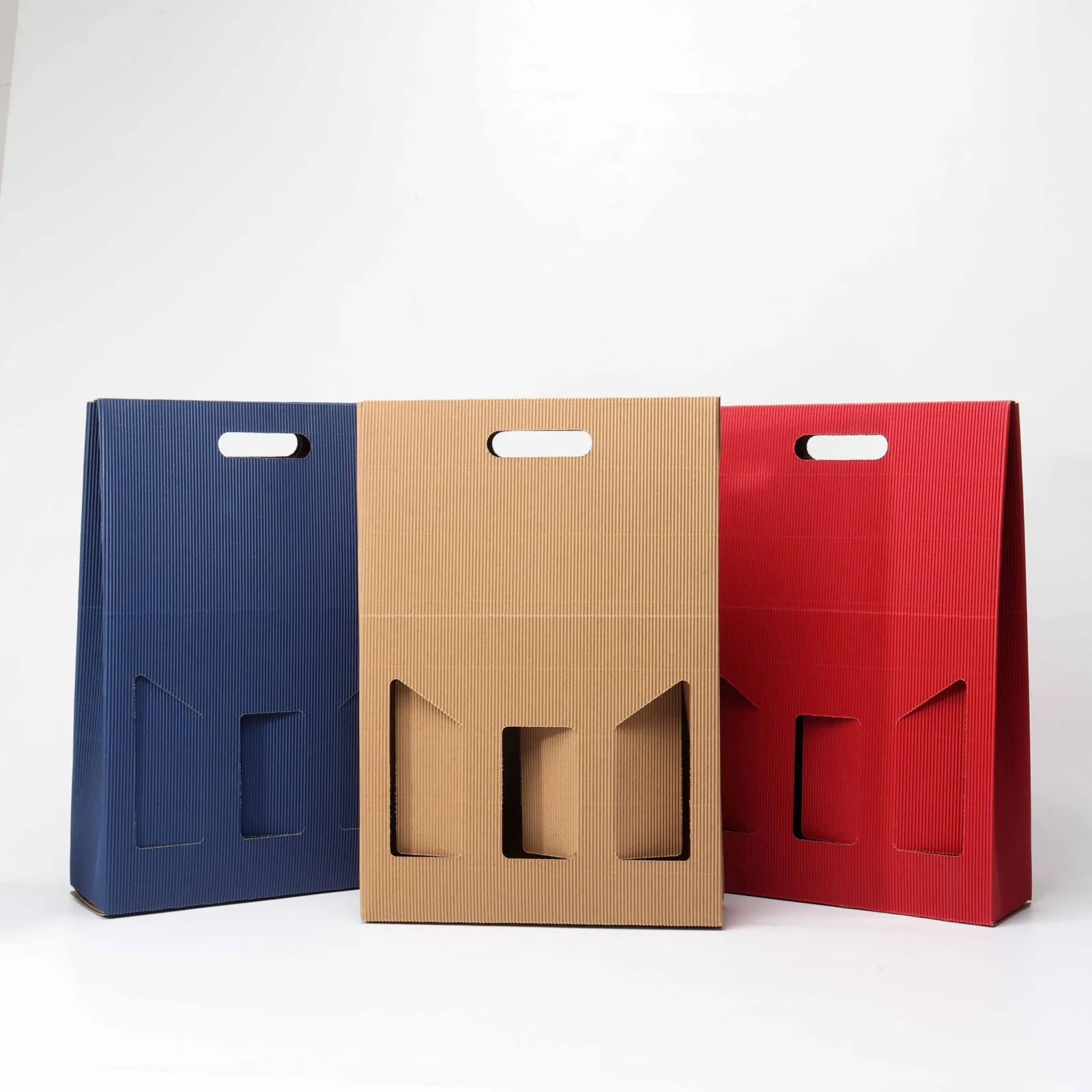
For multi bottle formats, think about how the box is carried. A three bottle box with a single handle puts load on one panel. A two bottle box with a divider is easier to keep rigid. If you are comparing formats, our range of wine shipping boxes is organised by bottle count so you can see how the structures differ.
- Single bottle: one cavity, one set of four contact points, easiest to control.
- Two bottle: divider or twin cavity, watch the centre panel for flex.
- Three bottle: often a wider box, check handle attachment and base support.
- Multi bottle: spacing and internal dividers decide whether bottles stay apart.
Corrugated or rigid? Usually both
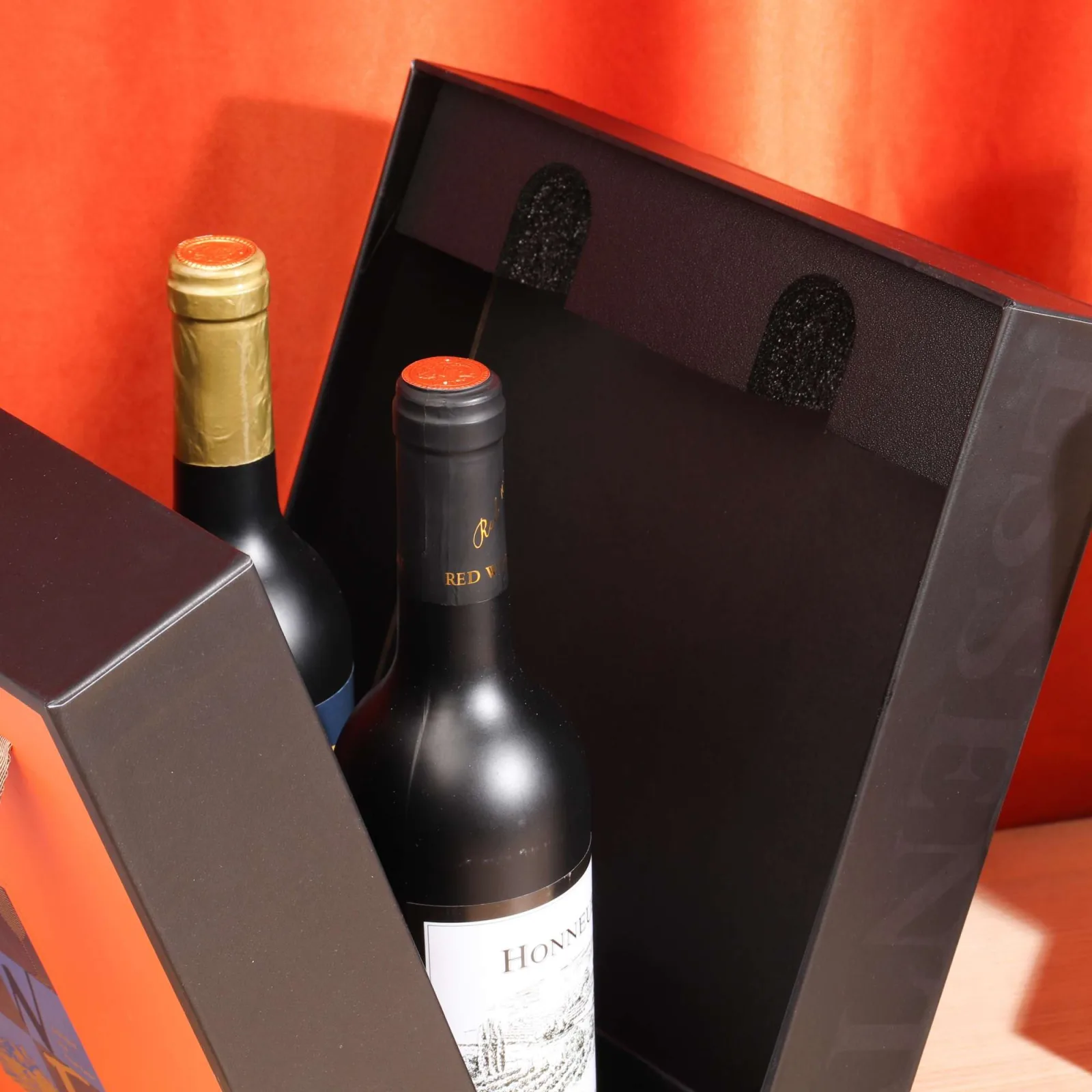
Corrugated shippers are for transit protection. They are lighter, they flex under impact, and they are built to take a drop without passing the shock to the bottle. Rigid boxes are for retail display and gifting. They hold their shape on a shelf, they take print and finish well, and they feel like a product, not a parcel. If your project has to survive a courier and then sit on a counter, you need both: a rigid retail box inside a corrugated shipper.
The mistake I see is a buyer choosing rigid for transit because it looks better. Rigid board does not absorb impact the way corrugated does. It transfers it. If the box is going through a parcel network, the outer layer has to be the one that takes the hit. The inner box can be as handsome as you like.
Some projects need the reverse: a corrugated outer that is printed and used as the retail pack. That works if the print is simple and the box is not expected to look pristine after handling. Be honest about which one your channel needs.
- Corrugated shipper: transit first, print second.
- Rigid box: display and gifting first, needs an outer shipper for transit.
- Both: rigid inner, corrugated outer, the safest combination for retail plus courier.
- Printed corrugated as retail: only if you accept scuffs and dents on the shelf.
Insert types and the four point rule
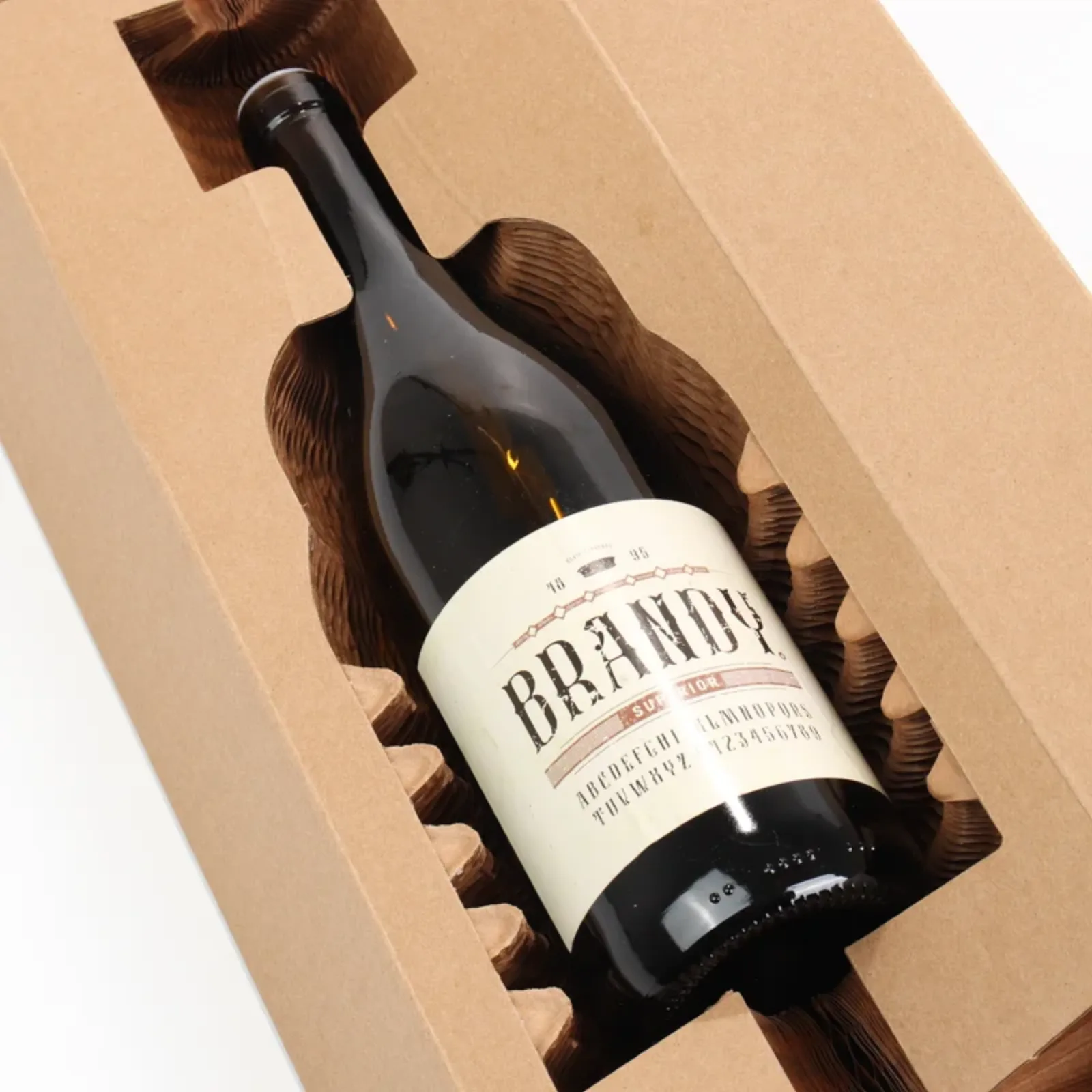
Velvet tray, EVA foam, blister, and paper mould (moulded pulp) are the four inserts we work with. Velvet gives a premium look and a soft contact surface. EVA foam is firm and holds shape, good for heavier bottles. Blister is a formed cavity, often used where you want a tight mechanical fit. Paper mould is the lightest and the most forgiving on cost, but it has less give than foam.
Whichever you choose, the insert rule is the same: the bottle must be held at four points, with no unsupported neck or shoulder. That means contact at the base, at the lower body, at the upper body or shoulder, and at the neck. If the neck is floating, the bottle becomes a lever in a drop and the shoulder takes the load. That is how necks crack.
The fit checks are simple and they are not optional. Shake the loaded box for 10 seconds: no movement. Tilt it to 45 degrees: no slide. Invert it: no release. If it fails any of those, the insert is wrong, not the bottle. We run these on the first article and again during production. You can read more about how these checks fit together in How to Ship Wine Bottles Safely.
- Velvet tray: premium look, soft contact, good for gift and retail.
- EVA foam: firm hold, suits heavier bottles and tighter cavities.
- Blister: formed mechanical fit, precise but less forgiving on bottle variation.
- Paper mould: light and economical, less shock absorption than foam.
Board and material choices
For rigid boxes, greyboard is the structural layer. Our standard is 1200 g minimum, and 1400 g recommended for spirits. Below that, the box flexes and the corners soften. Facing paper should be 157 g minimum, specialty or coated, because thinner paper shows the board texture through the print. We do not use recycled greyboard and we do not use high moisture paper. Recycled board is inconsistent in density, and high moisture paper moves after printing, which shows up as warping on the lid.
For corrugated shippers, the flute profile and the liner matter more than the board weight alone. A heavier liner resists puncture. A taller flute gives more cushioning but takes more space. If you are unsure which combination suits your route, our materials and structures page lays out the options we keep in regular use.
One more thing: the box body and the insert should be specified together. A perfect insert in a box that bows under load is still a failed pack.
- Greyboard: 1200 g minimum, 1400 g for spirits.
- Facing paper: 157 g minimum, specialty or coated.
- No recycled greyboard, no high moisture paper.
- Corrugated: check flute profile and liner, not just board weight.
Tolerances you should write down
Our control tolerance for the insert is plus or minus 1 mm. For the box body it is plus or minus 2 mm. Those numbers matter because a 2 mm box variation plus a 1 mm insert variation can add up to a loose bottle or a tight fit. If your bottle is at the top of its size range, tell us. We would rather adjust the cavity than ship a box that rattles.
For foldable boxes, the creases must not crack. That is a material and scoring issue, not a folding issue. Magnet position is held to plus or minus 1 mm, because a magnet that is off by more than that will not pull the lid shut cleanly. Corners should be 90 degrees when erected. If they are not, the box will not stack and the lid will not sit flat.
These are control tolerances, not guarantees. They are what we hold to during production, and they are what we check on the first article.
- Insert: plus or minus 1 mm.
- Box body: plus or minus 2 mm.
- Foldable: creases must not crack, magnet position plus or minus 1 mm.
- Corners: 90 degrees when erected.
Colour control and the hard colours
We match to Pantone, approve a first article, and sample mid run. That sequence catches drift before it becomes a whole batch. Black, deep blue and burgundy are the hardest to hold. Black shows any shift in density, deep blue shifts toward purple or green, and burgundy moves toward brown or red. If your brand colour is one of those, expect to spend more time on the first article and expect to check the mid run sample carefully.
A common failure is a buyer approving a printed sample under office light and then rejecting the production run under warehouse light. If the colour is critical, tell us the lighting conditions you will judge under. We can adjust, but only if we know what you are comparing against.
You can see how this fits into our wider process on our quality control page.
- Pantone matching, first article approval, mid run sampling.
- Black, deep blue and burgundy are the hardest to hold.
- Tell us the lighting you will judge under.
- Approve the sample under the same light as production.
Questions to ask a factory
Ask what board and insert they propose, and why. A factory that cannot explain the choice is guessing. Ask how they control fit: do they run a shake, tilt and invert check, and on what. Ask how they control colour: do they do a first article and a mid run sample. Ask what in-house pre-shipment checks they run. Ours are a 1.2 m six face drop test with the bottle loaded, a stacking top load of 40 kg or more for 24 hours, and a truck and sea vibration simulation with no internal movement.
If a supplier cannot describe those checks, you are the quality control. That is a risk you can choose to take, but price it in.
One more question: what happens if the first article fails? A good factory will tell you before you ask.
- What board and insert do you propose, and why?
- How do you control fit, and what checks do you run?
- How do you control colour, and when do you sample?
- What in-house pre-shipment checks do you run?
- What happens if the first article fails?
When our product is the wrong answer
We make wine boxes and wine bags. If you need insulated or cooler bags, neoprene, plastic, glass, metal tins, or bottle labels, we do not make those. Saying so saves us both time. A buyer looking for a cooler bag will not find it here, and a buyer looking for a rigid gift box with a velvet tray will.
If your project is a mixed pack with a bottle and a glass, or a bottle and a tool, we can quote the box, but the non bottle components are outside our scope. Be clear about what you are packing, and we will tell you if we can hold it.
The same goes for anything that needs to be food contact approved or regulated. We do not make those claims. If that is a requirement for your market, you need a different supplier.
- We do not make insulated or cooler bags, neoprene, plastic, glass, metal tins, or bottle labels.
- Mixed packs: we quote the box, not the non bottle contents.
- No food contact or regulatory claims.
- If your requirement is outside our scope, we will say so.
What to send us, and how we start
Send box dimensions or a bottle sample, a reference design, your quantity, and any special requirements. If you have a bottle, send it. A sample tells us more than a drawing. If you do not, send the diameter and height and we will work from that. For custom work, our custom wine shipping box manufacturing page explains the process.
We offer two sample types: a blank sample for structure, and a printed sample for visual. Use the blank sample to check fit and the printed sample to check colour and finish. We recommend sample before mass production so you can approve both before we run the order.
Our eight production steps are online consultation, design confirmation, plate making and proofing, machine printing, machine lamination, machine box making, hand assembly, and quality inspection and packing. Each step is a checkpoint. If something is wrong, we want to find it at proofing, not at packing.
- Send box dimensions or a bottle sample, reference design, quantity, special requirements.
- Blank sample for structure, printed sample for visual.
- Sample before mass production.
- Eight steps: consultation, design, plate making and proofing, printing, lamination, box making, hand assembly, inspection and packing.
Key points
- Measure your bottle, not a catalogue spec. Diameter and height drive the insert.
- Corrugated for transit, rigid for display. If you need both, use both.
- The bottle must be held at four points with no unsupported neck or shoulder.
- Write down tolerances: insert plus or minus 1 mm, box body plus or minus 2 mm.
- Ask what in-house checks the factory runs. If they cannot say, you are the quality control.
Questions buyers ask
What is the difference between a wine shipping box and a wine gift box?
A shipping box is built for transit, usually corrugated, and its job is to absorb impact. A gift box is built for display, usually rigid, and its job is to look good on a shelf. If you need both, use a rigid box inside a corrugated shipper.
Can you make a custom insert for my bottle shape?
Yes. We work with velvet tray, EVA foam, blister, and paper mould. Send a bottle sample or the diameter and height and we will build the cavity so the bottle is held at four points with no unsupported neck or shoulder.
What checks do you run before shipment?
Our in-house checks are a 1.2 m six face drop test with the bottle loaded, a stacking top load of 40 kg or more for 24 hours, and a truck and sea vibration simulation with no internal movement. We also run shake, tilt and invert fit checks on the first article.
Send your box dimensions or a bottle sample, reference design, quantity, and special requirements, and ask for a blank sample for structure and a printed sample for visual. Get a Quote
Put this on your bottle
Send the bottle sample or dimensions, quantity and a reference design. We reply with structure options and pricing.
- Email[email protected]