08 August 2026
How to Ship Wine Bottles Safely
Bottles break because the neck and shoulder are unsupported and the outer box loses stiffness. The best way to ship wine bottles is to fix the bottle at four points, use a rigid outer board, and run your own transit checks before dispatch. That is the whole method in one line.
Why Wine Bottles Break in Transit
Most breakage is not random. A bottle has two weak points, the neck and the shoulder. If the insert leaves those areas hanging, every bump or drop puts stress exactly where the glass is thinnest. The second common failure is the outer box itself. Corrugated board softens with moisture and repeated handling. Once the box loses stiffness, the insert moves, the bottle shifts, and the neck takes the load. That is the whole story in two sentences.
You can solve both problems without overpaying. The insert has to support the bottle at four points. The outer board has to stay rigid through the worst part of the journey. If either part is weak, the other cannot save it. I have seen boxes fail because the insert was perfect but the outer box was a thin single wall. And I have seen the opposite, a strong outer box with a foam tray that let the bottle slide sideways.
Step One: Fix the Bottle at Four Points
The rule we use in our own production is simple. A bottle must be held at four points, never by the neck or shoulder alone. Those four points are usually the base, the lower body, the upper body just below the shoulder, and the neck itself. When all four points touch the insert, the glass cannot flex or rattle. You can test this at your desk. Put the bottle in the insert and push down on the neck. If the neck moves even a millimetre, the insert is not doing its job.
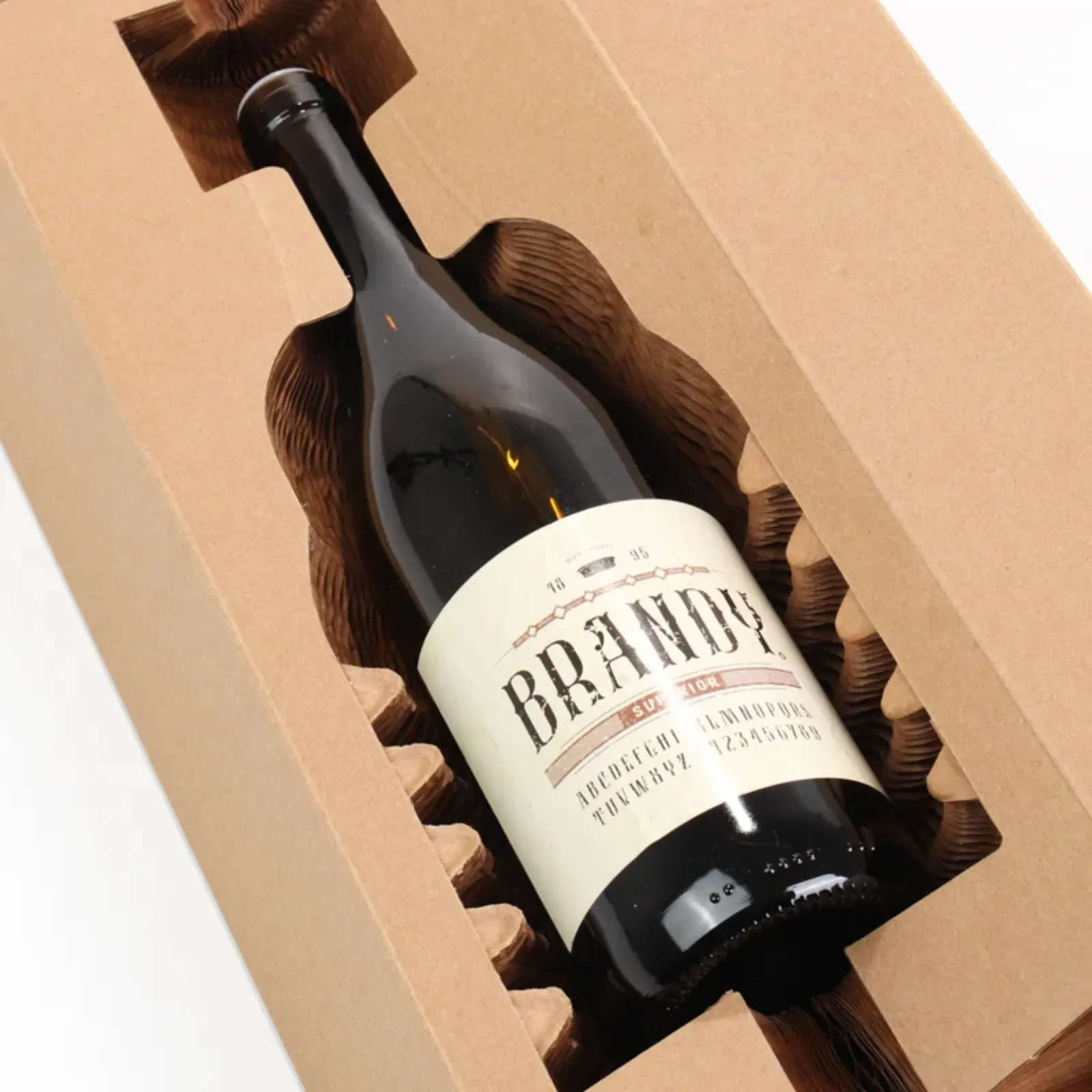
This is why we reject moulded pulp trays that only grip the base and leave the neck floating. It looks fine in a photo. It fails in a courier van that gets loaded three times before it reaches the customer. A good insert is boring. It holds the bottle still, every time, in every orientation. If you want to see how we build that into single bottle packs, look at our single-bottle wine boxes.
Step Two: Pick the Right Insert
Each insert has a trade-off. Moulded pulp is the budget option. It protects well enough for short domestic runs, but the tolerance is wider. If your bottle has an unusual shoulder, pulp may not grip it. EVA foam is the safest choice for long hauls or heavy spirits. We cut it to plus or minus one millimetre. Blister inserts are popular for retail sets where the customer sees the bottle through a window. A die cut board tray is my default for a rigid box because it adds structural strength to the outer pack.
Do not choose an insert by price alone. Choose it by the worst journey the box will face. A wine shipper insert that works for a palletised truck load may fail when a courier drops the box on concrete. If you are unsure, send us your bottle sample. We will match the insert to the bottle shape and the route.
- Moulded pulp is light and cheap but less precise. It works for standard 750 ml bottles with consistent shapes.
- EVA foam gives the best shock absorption and can be cut to tight tolerances. It costs more and adds weight.
- Blister inserts show the bottle clearly and hold it firmly. They are less forgiving if the bottle shape varies.
- Die cut board trays are recyclable and rigid. They suit heavier bottles but need careful creasing to avoid cracking.
Step Three: Choose the Outer Board
The outer board is not just a shell. It is the frame that keeps the insert in place. Our standard is greyboard at 1200 g minimum. For spirits or any bottle over one kilogram, we recommend 1400 g. The facing paper should be at least 157 g specialty or coated stock. We do not use recycled greyboard because it varies in density and soaks up moisture. We also avoid high-moisture paper for the same reason. A box that absorbs humidity from a sea container will soften and lose its corners.
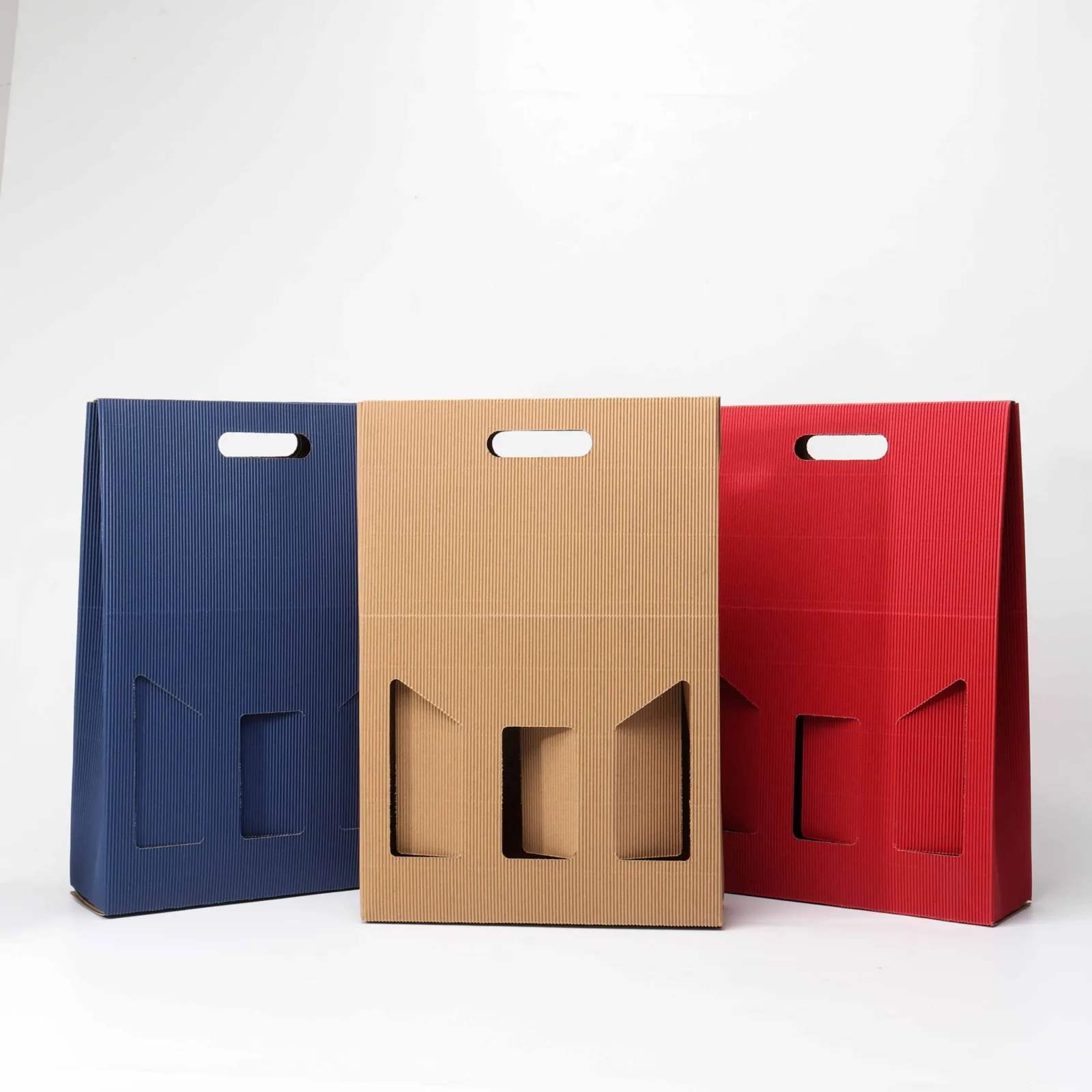
This is where a cheap quote hides a real cost. A thin board saves a few cents per unit. Then you pay for it in breakage, returns and customer complaints. When we build corrugated wine shippers, we treat the board as a structural part, not a commodity. You can read more about our material rules on the materials and structures page.
Step Four: Check the Fit Yourself
You do not need a lab to catch most problems. Three checks will tell you if the pack is safe. First, shake the closed box for ten seconds. You should hear and feel no movement. Second, tilt the box to 45 degrees. The bottle must not slide. Third, invert the box completely. The bottle must not release from the insert. If it fails any of these, do not ship it.
These are the same checks we run on every new insert design before we approve it for production. They are quick, repeatable and brutally honest. A box that rattles in your hand will rattle in a van. A bottle that slides at 45 degrees will hit the wall of the box on the first sharp turn. Invert the pack and you simulate the worst handling a courier can give it. If the bottle stays put, you have a real wine bottle shipper.
Step Five: Test Against Transit
Fit checks are not enough. You also need to know how the pack behaves under load and vibration. Our in-house checks are designed for that. We drop a loaded box from 1.2 metres on all six faces. We stack a top load of 40 kg or more on it for 24 hours. We run a vibration simulation that mimics truck and sea movement and check for internal movement afterwards. These are our own checks, not a third party standard, and we run them before dispatch on sample lots.
Be clear about what this does and does not tell you. A drop test shows whether the insert absorbs shock. A stacking test shows whether the board keeps its shape under a pallet. The vibration test shows whether the bottle works loose over time. Together they catch the failures that happen in real shipping. If your current supplier cannot show you similar checks, ask why not. You can see how we apply these checks in our quality control process.
Pre-dispatch Checklist
Run this list on every new box, every new bottle shape and every new route. It takes five minutes and it saves you from the email you do not want to write, the one that starts with a photo of broken glass. If you are building a custom pack, send us the bottle dimensions or a sample, your reference design and the quantity. We will work through the insert, the board and the checks with you. Start with custom wine shipping box manufacturing if you want to see the full process.
- Bottle is fixed at four points with no unsupported neck or shoulder.
- Insert tolerance is within plus or minus 1 mm and box body within plus or minus 2 mm.
- Outer board is greyboard 1200 g minimum, 1400 g for spirits, facing paper 157 g minimum.
- Shake test for 10 seconds shows no movement, tilt at 45 degrees shows no slide, invert shows no release.
- Drop, stacking and vibration checks are done on a sample from the production lot.
Key points
- Support the bottle at four points, never by neck or shoulder alone.
- Match the insert to the route: pulp for short hauls, EVA for long or heavy.
- Use greyboard 1200 g minimum, 1400 g for spirits, facing paper 157 g.
- Shake, tilt and invert every new pack before you ship it.
- Run drop, stacking and vibration checks on a sample lot.
Questions buyers ask
What is the best insert for shipping wine bottles?
It depends on the route and the bottle. EVA foam gives the best shock absorption and tightest fit, so it is our default for long hauls and heavy spirits. Moulded pulp is cheaper and fine for standard bottles on short domestic runs. A die cut board tray adds rigidity to a rigid box. Blister inserts work well for retail display packs.
How much board weight do I need for a wine shipping box?
We use greyboard at 1200 g minimum for all wine boxes. For spirits or any bottle over one kilogram, we recommend 1400 g. The facing paper should be at least 157 g specialty or coated stock. We do not use recycled greyboard or high-moisture paper because they soften and lose stiffness in transit.
How can I test a wine shipping box before dispatch?
Start with three fit checks: shake the closed box for ten seconds and listen for movement, tilt it to 45 degrees and watch for sliding, then invert it fully to see if the bottle releases. For more confidence, run a loaded drop from 1.2 m on all six faces, stack 40 kg on top for 24 hours, and simulate truck or sea vibration.
Send us your bottle dimensions or sample and we will work through the insert, board and transit checks with you. Get a Quote
Put this on your bottle
Send the bottle sample or dimensions, quantity and a reference design. We reply with structure options and pricing.
- Email[email protected]